
Scroll through Twitter after any exciting moment ignited by Willson Contreras and you’ll find multiple #ExtendWillson tweets on your timeline. Big hits, back-picks, and caught-stealing are his signature and as fans, we love all of it. After the 2021 sell-off of The Core, Contreras became ingrained as the heart and soul of a team that sorely needed a leader. The Cubs’ backstop plays at full throttle and is as passionate a player as they come. He is very clearly the captain of this Cubs team, so it baffles many fans as to why the Cubs and Contreras haven’t agreed to a contract extension yet. In 2022, Willson’s offensive numbers have jumped, likely due to the DH finally implemented in the National League and the Cubs signing Yan Gomes as his backup allowing the Cubs to rest Contreras but keep his bat in the lineup. He’s currently sporting a 141 wRC+ (ranks 30th in MLB across all positions) and .375 woBA (ranks 23rd) which tops all catchers with a minimum of 100 plate appearances. His 57.1% hard-hit percentage and 92.7 average exit velocity rank 4th and 11th, respectively, in all of baseball. He’s doing yard work. He’s raking. Whatever metaphor you want to use, it fits Willson’s dominant performance at the plate in 2022.
So why won’t the Cubs commit to an extension with their catcher who can also DH? As Jed Hoyer, Carter Hawkins, and the Cubs front office look to build the “next great Cubs team”, I wonder if they don’t view Contreras as a catcher who can DH, but instead a DH who can also catch. It’s a subtle difference, but the Cubs may not be willing to pay Contreras like the best hitting catcher in the game if they don’t view him as their catcher in 2023 and beyond. There’s no question he can hit, but based on Baseball Savant’s catcher framing metrics, Contreras isn’t doing his pitching staff any favors with his receiving skills. Of 200 catchers since 2015, Contreras has the 15th lowest Catcher Framing Runs at -17. Per Baseball Savant, “Catcher Framing Runs converts strikes to runs saved on a .125 run/strike basis, and includes park and pitcher adjustments.” That means Contreras cost Cubs pitchers 17 runs since his call-up in 2016 because of his pitch receiving. That sounds harsh and I don’t mean to slander the guy, but that’s how a negative Catcher Framing Runs metric is interpreted.
One catcher comparison to call out here is JT Realmuto of the Philadelphia Phillies who is considered one of the best catchers in the game. Realmuto signed a five-year $115.5M contract with the Phillies before the 2021 season, making him the highest paid catcher in MLB history at $23.1M per year. Since 2015, Realmuto ranks 30th/200 with 7 Catcher Framing Runs, though this season he’s having a down year at the plate with 83 wRC+ (17% below league average).
Other Cubs catchers on this list:
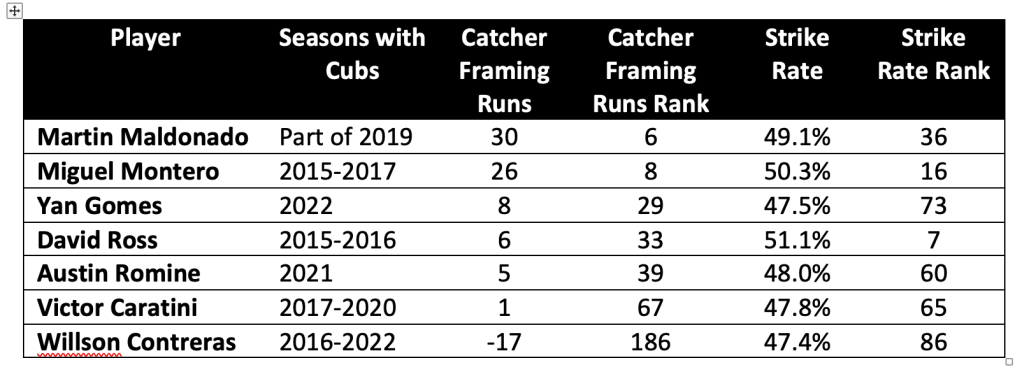
Five of the Cubs’ backup catchers since 2015 are in the top 40 in Catcher Framing Runs, which makes sense. Teams typically don’t sign backup catchers because of their offense, so the value a backup catcher brings is with their pitch receiving skills (and if a backup catcher has elite offensive skills, he’s usually not a backup).
In 2019, the Cubs hired assistant GM and VP of pitching Craig Breslow which kicked off the Cubs’ overhaul of their pitching development infrastructure. We’re just starting to see the results of that investment. Pitchers like Justin Steele, Keegan Thompson, Brandon Hughes, and Scott Effross are some of the first among other homegrown pitching talents the Cubs have developed. To maximize that investment in 2023 and beyond, maybe a catcher who can buy more strikes is a key part of the strategy. Part of the knock on the Cubs with the previous core players was that they didn’t continue their development at the major-league level once they arrived. Jed Hoyer & Co. may be more keen to avoid repeating that mistake with these new young arms. A catcher who can deliver more strikes on borderline pitches may be an important factor in the major-league development of the pitching prospects the Cubs have invested in.
That doesn’t mean there isn’t a place for Contreras on the roster beyond this season, it just may mean he transitions to the starting DH with catching duties on the side. And maybe that’s the disconnect between the Cubs and Contreras. Contreras likely wants to be paid like a top catcher and JT Realmuto’s contract doesn’t do the Cubs any favor in negotiations, but the Cubs shy away from paying for past performance, and that’s probably especially true if they don’t see Contreras in the same catching role he’s filled since his call-up in 2016.
The Chicago Cubs won the World Series that year. People forget that.
There are so many reasons the Cubs should extend Willson Contreras. His bat, leadership, and passion make him a player I want as a cornerstone of the Cubs for the next five years. I have a hard time thinking the Cubs can compete in 2023 if Contreras isn’t on the roster. Removing him from the roster feels like more of a tear-down than building toward the playoffs in 2023. But there has been basically zero momentum to achieve the contract extension which makes it feel pretty likely that Contreras gets dealt to a playoff contender at the trade deadline. If that happens, his pitch receiving may be a reason why. Both the Cubs and Contreras could benefit from fewer innings caught but keeping his bat in the lineup. To me, that brings more value to the Cubs than any potential prospect return via trade. So Jed, figure out how to make him a starting DH and platoon catcher for the next five years and let’s forget we ever had to think about Willson in a different uniform.
 The 368 Project