
Before Kyle Hendricks takes the mound for the second game of the Crosstown Series with White Sox on May 4th, I wanted to dig into his early season results. Through five starts this season, Kyle Hendricks hasn’t pitched like a frontline starter at the top of the Cubs’ rotation. It’s been a few seasons since we’ve seen him be truly elite (not-so-humble brag: I was at Wrigley when Kyle outdueled Kershaw in Game 6 of the 2016 NLCS to clinch the pennant. *chef’s kiss*). But it’s fair to say Kyle is a much better pitcher than what we’ve seen early in 2022.
The Results
Anecdotally, anyone who’s watched Kyle Hendricks pitch this season could tell you he’s not pitching like the same Kyle Hendricks for whom we’ve set such a high bar. But you didn’t come to The 368 Project for “anecdotally”, so let’s check out his early 2022 results and contrast them to previous seasons.

Comparing his first five starts in the 2022 season to previous seasons, Kyle’s current:
- Ground ball percentage (GB %) is at a career low
- Fly ball percentage (FB %) is near his career high (higher fly ball rate makes a pitcher more susceptible to home runs – he’s given up four homers through five starts: two on fastballs and two on changeups)
- Line drive (LD %) percentage is at a career high
- Barrel %, barrels per plate appearance (Barrel/PA), sweet spot %, hard-hit %, and exit velocity (of batted balls) are all at career highs
- Walk rate (BB%) and ERA are at career highs
- K % is the second lowest of his career
His 10% walk rate is tied for eighth worst in baseball. He’s only had one season higher than a 6% walk rate, so he’s clearly not locating his pitches in the strike zone as consistently as his reputation holds. This stat is a reason for optimism- he’s not going to finish the season with a 10% walk rate. Better pitch location execution will drop his walk rate and ultimately his hard-hit numbers would likely fall, too. The Professor just isn’t pitching very Professor-y right now.
Per FanGraphs, his 40.8% hard-hit % is good for fifteenth-highest among all qualified pitchers in Major League Baseball this season. All data points mentioned above can be interpreted to mean that Kyle is neither missing many bats nor inducing soft contact. What is he throwing that’s getting hit so hard?
The Arsenal
Kyle’s four-pitch repertoire consists of a sinking fastball, changeup, four-seam fastball, and a curveball. Per Baseball Savant, the sinker is his most-thrown pitch. Here are the frequencies at which he’s thrown each pitch this season:
| Pitch | Frequency | Change from 2021 |
| Sinker | 33.5% | -9.2% |
| Changeup | 29.4% | +1.6% |
| Four-seam Fastball | 27.2% | +9.4% |
| Curveball | 10.0% | -1.7% |
And here’s the batted ball data on those pitches from Baseball Savant:
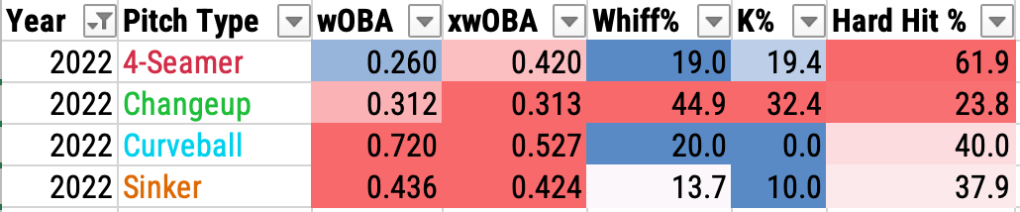
In attempting to diagnose the hard-hit struggles Kyle is experiencing, let’s start with the pitches he throws most often and work our way down.
The Sinker
Kyle’s 33.5% frequency on the sinker is not just down from 2021, it’s the lowest frequency he’s ever thrown the pitch. He’s thrown sinkers as more than 40% of his offerings in six of the last nine seasons. He’s well below that mark so far in 2022 which is a likely contributor to the career-low ground ball rate of 35.5% through five starts (sinking fastballs drop as they approach home plate causing hitters to make contact with the top half of the ball which results in a ground ball. If he’s throwing fewer sinkers, it makes sense that his ground ball rate is also reduced). Hendricks is generating a 13.7% whiff rate on his sinker which is in line with 2021 and falls somewhere in the middle of his whiff% range since 2017. The whiff rate itself doesn’t signal any issues, but we can also see:
- hard hit % is the second highest since 2017
- weighted on-base average (wOBA) is by far the highest since 2017
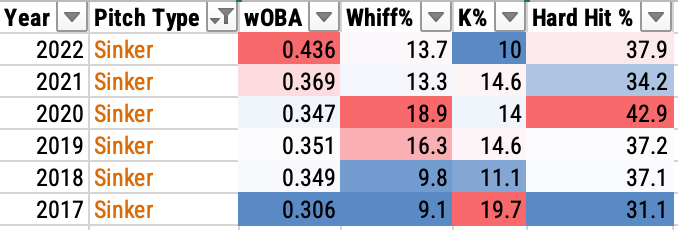
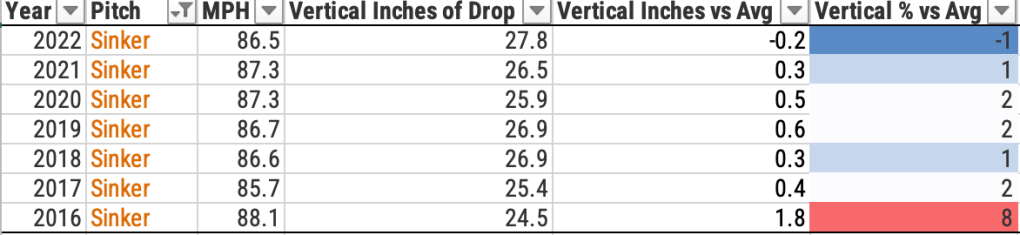
Hitters are having more success against Kyle’s sinker this season. One possible reason for that: for first time since 2016, the vertical drop % on that pitch is lower than similar sinkers thrown by other MLB pitchers (“similar” means within 2 MPH and within 0.5 feet of extension and release, per Baseball Savant). The vertical movement on Kyle’s sinker is 27th in all of baseball. And it’s not necessarily that Kyle’s sinker has gotten worse, but that other sinkers in the game have gotten better. Hitters have had to adjust to better sinkers, and Kyle’s isn’t one of them. From a hitter’s perspective that means Kyle’s sinker isn’t uniquely difficult to hit right now, due to the vertical movement not being as steep as other sinkers they face. A .436 wOBA (and .424 xwOBA) indicates hitters’ success against the pitch. Hitters are producing five runs above average (run value = 5) against Hendricks’ sinker.
The Changeup
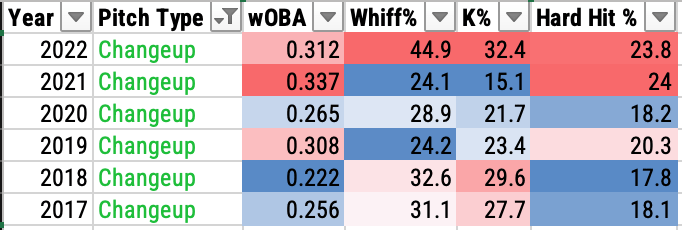
Hendricks’ changeup is his second most-used pitch this season at 29.4%. Per FanGraphs, he’s in the top three frequency of changeups thrown in all of baseball in 2022 behind Pablo Lopez of the Miami Marlins (37.8%) and Logan Webb of the San Francisco Giants (35.9%). The vertical movement he’s getting on the changeup is thirteenth most in baseball. He’s throwing that pitch slightly more than he has in past seasons, but very much in line with previous usage. Of Hendricks’ four pitch types, he gets the lowest hard-hit rate and highest strikeout rate on his changeup. Hitters have a .312 wOBA against the pitch which is just north of the league average wOBA of .305 (against all pitches, not just changeups). Overall, hitters aren’t producing any runs above average against his changeup (run value = 0).
The 4-Seam Fastball
Kyle is throwing his four-seamer 27.2% of the time. That’s nearly 10% higher than last season and would top his previous career high of 23.4% in 2017 if he continues that usage rate. He’s throwing the pitch more often than he ever has before but getting the lowest whiff rate and highest hard-hit percentage. Not a great combination. The four-seam fastball is by far the hardest hit pitch, but hitters have a below-average .260 wOBA against it. The expected wOBA (xwOBA) is .420 which indicates his four-seamer is getting hit hard right at his defense and/or his defense is making great plays for outs on hard-hit fastballs. The hard-hit rate of 61.9% is eighth highest in all of baseball among pitchers with at least 25 plate appearances faced. Hitters are producing three runs below average on this pitch, but that probably isn’t sustainable if the hard-hit numbers don’t come down.

A higher usage rate on his four-seam fastball helps set up his changeup to be used more effectively and we’re seeing some evidence of that with the relative success of his changeup. We don’t necessarily want to see Hendricks reduce his fastball usage for that reason, but future changeup success may depend on being able to locate his 4-seam fastball more consistently. With better pitch location execution, his hard-hit rate on the 4-seamer probably settles somewhere closer to 50%.
The Curveball
There’s not a lot to evaluate on Kyle’s curveball. He’s only thrown it 10.0% percent of all pitches this season which comes out to 41 total pitches in a limited sample size of five starts. Those 41 pitches came in only five plate appearances. Hitters are 4-for-5 against the pitch with four singles. Those aren’t great outcomes, but there’s no sense in signaling a five-alarm fire by saying the wOBA against this pitch is .720. Room for improvement, sure, but this pitch is at most is a small reason for his early-season struggles.
The Takeaways
Kyle Hendricks’ 40.8% hard hit rate is among the highest in baseball so far this season. To take his name off that list, he needs better pitch location execution. Asking Kyle to be the 2016 version of himself would be asking for consistent Hall-of-Fame-worthy performances. That’s not a fair expectation at this point, but a sub-3.80 ERA feels like a reasonable result that would present the Cubs with a solid top-half-of-the-rotation starting pitcher. He’s likely not an ace on the “next great Cubs team”, but that’s the role he’ll need to fill on the current “mediocre at best” version of the Cubs. He’s the cornerstone of the Cubs’ rotation and his early numbers are just that: early. I’m optimistic Kyle will return to form.
Now go dominate the Sox, Kyle.
 The 368 Project